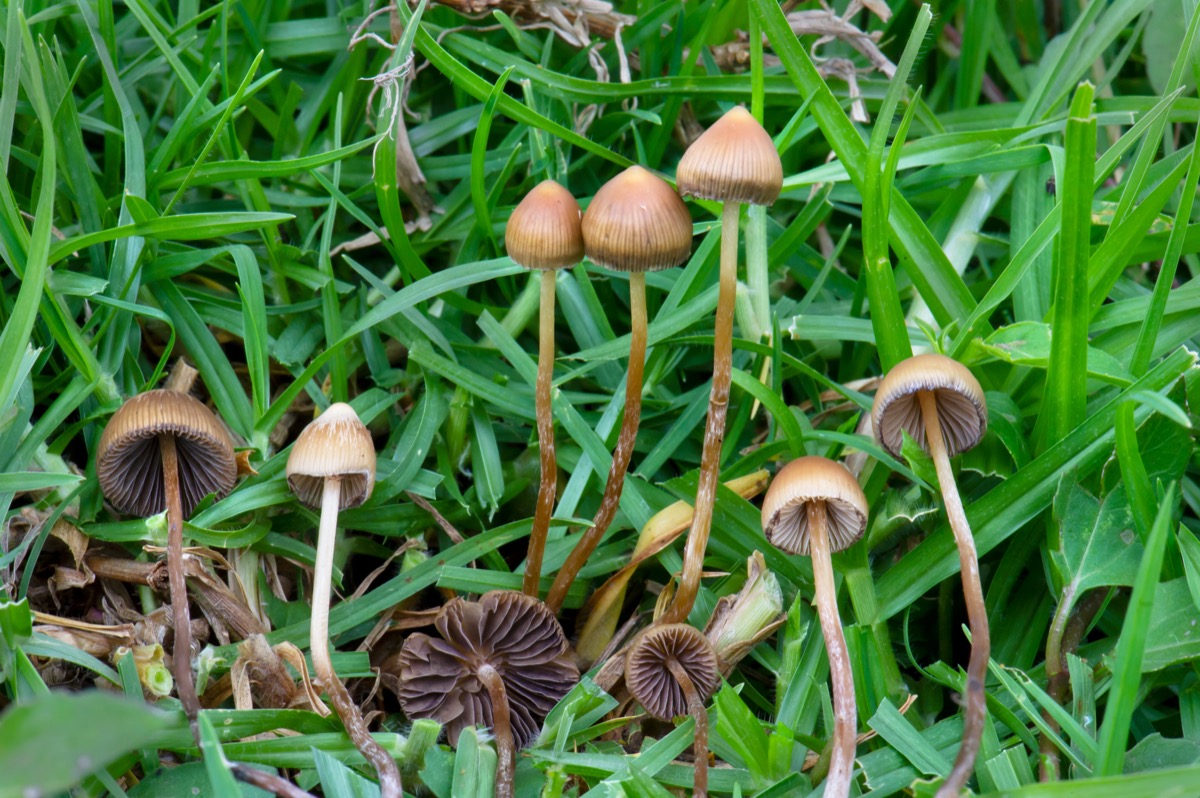
Psilocybin Mushrooms · Psilocybe mexicana
Psilocybe mexicana
Psilocybe mexicana is arguably the most historically significant psilocybin mushroom species. It is the species used by Mazatec curandera María Sabina in the traditional velada ceremonies documented by ethnomycologist R. Gordon Wasson in 1957 — the event that introduced psilocybin mushroom use to Western awareness for the first time.
In 1958, Swiss chemist Albert Hofmann — who had previously synthesized LSD in 1943 — isolated psilocybin and psilocin from a batch of P. mexicana specimens sent to him by Wasson. This was the first chemical identification of these compounds, enabling their synthesis and the subsequent half-century of pharmacological research.
P. mexicana produces sclerotia — hard, truffle-like nodules of compressed mycelium that form underground. These 'philosopher's stones' or 'truffles' are also psychoactive and have become the basis of a legal grey market in the Netherlands, where psilocybin mushroom fruiting bodies are prohibited but sclerotia-producing species remain in an unclassified status as of 2024.
Potency is mild relative to other psilocybin species: approximately 0.25% psilocybin by dry weight in fruiting bodies. Sclerotia are typically less potent than fruiting bodies of the same species.
Active Compounds
Psilocybin, Psilocin, Baeocystin
P. mexicana grows in humid, sub-tropical mountain grasslands and forest margins of Oaxaca and other southern Mexican states, at elevations of 1,000–1,800m, typically near streams and on roadsides in mossy areas. It fruits in the late rainy season (June–October) in its native habitat.
The fruiting body is small: cap 0.5–2cm, conical to campanulate, pale buff-brown, often striate. Gills are pale grey-brown maturing to dark purple-brown. The stipe is smooth, cream to orange-brown, and bruises blue-green.
Sclerotia of P. mexicana are rounded, brown, irregular hardened masses forming 1–3cm underground. They have a denser texture than the fruiting body and a mild earthy flavour.
Hofmann's landmark synthesis of psilocybin from P. mexicana made the compound available for pharmaceutical research, eventually leading to the contemporary clinical trial landscape. The Mazatec tradition that Wasson documented continues today.
- Scientific Name
- Psilocybe mexicana
- Potency
- Mild
- Origin
- Southern Mexico — Oaxaca, Puebla, Mexico State