Functional Mushrooms · Hericium erinaceus
Lion's Mane
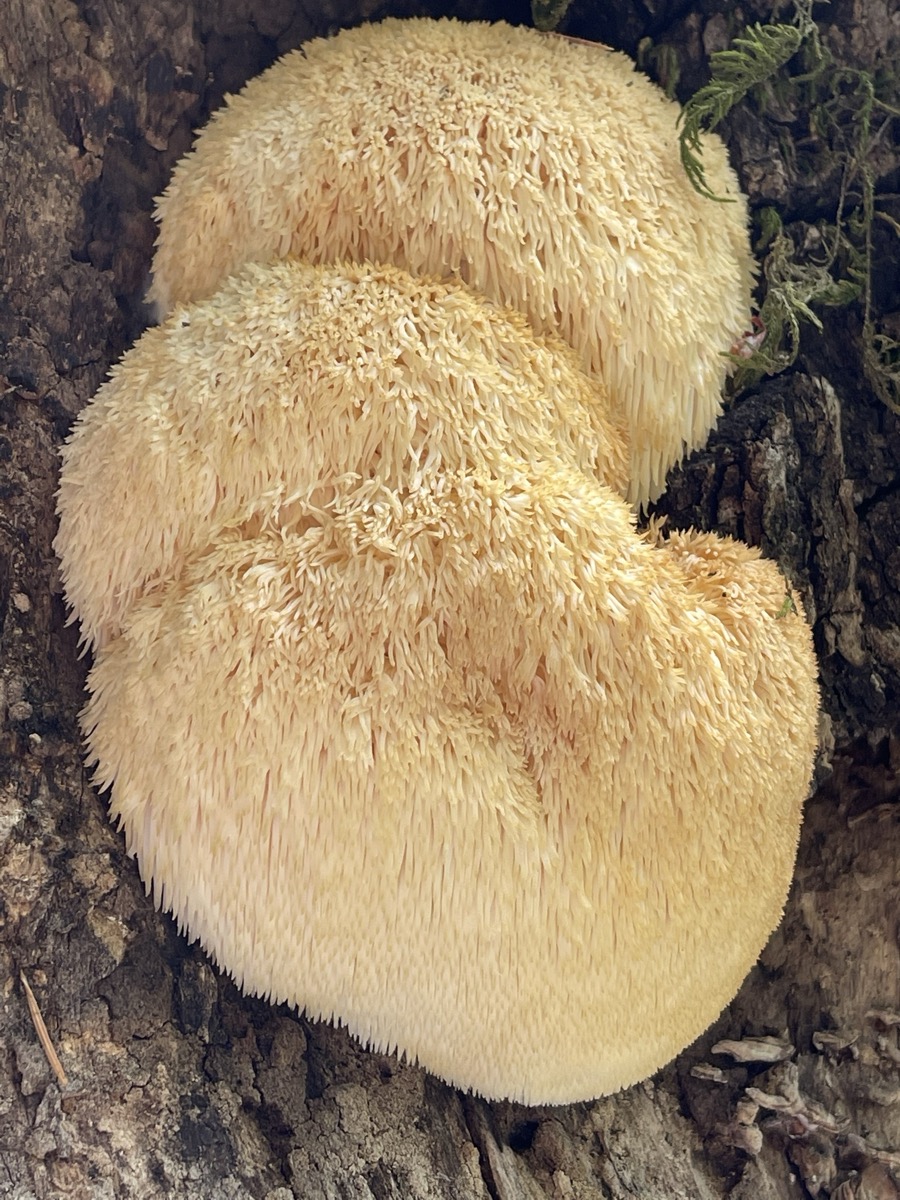
Lion's Mane is a large, white, shaggy mushroom found on dead or dying hardwood trees throughout North America, Europe, and Asia. Its cascading icicle-like spines — from which it draws its name — give it a profile unlike any other mushroom in the boreal forest.
The most widely cited research on Lion's Mane focuses on two unique compound families: hericenones (found in the fruiting body) and erinacines (found in the mycelium). In a 2009 double-blind, placebo-controlled trial published in *Phytotherapy Research*, Mori et al. found that subjects aged 50–80 taking 3g/day of Lion's Mane powder showed significantly improved scores on the Hasegawa Dementia Scale versus placebo. The researchers noted that improvements reversed after supplementation ceased.
Subsequent research has explored potential NGF (Nerve Growth Factor) synthesis stimulation. Studies by Kawagishi et al. suggest that hericenones and erinacines may promote NGF expression, which is important for the growth and maintenance of neurons. A notable advantage: these smaller molecules appear capable of crossing the blood-brain barrier, which is uncommon among fungal polysaccharides.
Active Compounds
Hericenones, Erinacines, Beta-glucans (1,3 / 1,6), Hericerins, Sterols, Polysaccharides, Amylase, Laccase
Lion's Mane grows on wounded or dead hardwoods — particularly oaks, beeches, and maples — in North America, Europe, and Asia. In Canada it fruits from late summer through early winter. The fruiting body is white to cream, occasionally yellowing with age, and entirely covered with soft, downward-hanging spines 1–5cm long.
It is a well-regarded edible with a flavour profile described as mild and seafood-adjacent, often compared to crab or lobster. Texture is firm and meaty when fresh, with high water content that reduces significantly on cooking.
Commercially available as fresh fruiting body, dried powder, dual-extract tincture, or standardized extract (typically 30% polysaccharide content). Research preparations have typically used 3–5g/day of dried fruiting body powder. Erinacine-rich products should specify mycelium-origin sourcing.
Origin: North America, Europe, and East Asia. Commercial cultivation uses hardwood sawdust substrate.
- Scientific Name
- Hericium erinaceus
- Origin
- North America, Europe, East Asia